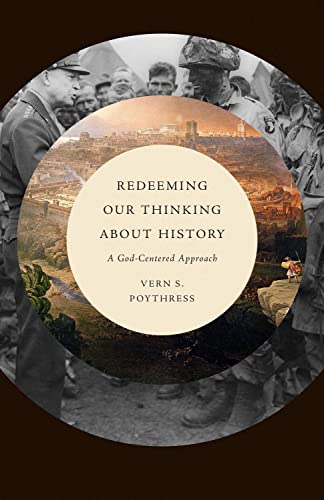
How does our knowledge of the past shape our views of God, Christ’s redemption, and humanity? Poythress teaches believers how to study and write about history, grounded in God’s command to remember his works and pass them on to the next generation. Topics include providentialism, Christian historiography, divine purpose, and the four basic phases of biblical history: creation, fall, redemption, and consummation.
Learning to study history well helps believers recognize God’s lordship over all events, including minor ones, and how they fit into his overarching plan.
A resource for seminary students, pastors, and historians, explaining how to write about history, understand divine purposes, and explore history in the Bible; it shows how to glorify God by recognizing his work throughout history.
Author
Author: Vern S. Poythress
Vern S. Poythress Vern S. Poythress holds a PhD from Harvard University and a ThD from the University of Stellenbosch. He is Distinguished Professor of New Testament, Biblical Interpretation, and Systematic Theology at Westminster Theological Seminary in Philadelphia, where he has taught for four decades. He has earned six academic degrees and has written numerous books and articles on biblical interpretation, language, and science.
Product Details
- Category: Theology; History & Biography; Apologetics
- Format: Paperback
- Page Count: 256
- Size: 5.5 in x 8.5 in x 0.75 in
- Weight: 11.06 ounces
- ISBN-10: 1-4335-7144-7
- ISBN-13: 978-1-4335-7144-2
- ISBN-UPC: 9781433571442
- Published: March 15, 2022
- Publisher: Crossway
Table of Contents
- Chapter 1: The Importance of History
- Part 1: What We Need in Order to Analyze History: Essential Resources That God Supplies
- Chapter 2: Experiencing History
- Chapter 3: Foundations for Historical Analysis
- Chapter 4: Spiritual Antithesis: Darkness and Light
- Chapter 5: Reductionistic Historical Analysis
- Chapter 6: Understanding People
- Chapter 7: Understanding Historical Causes
- Chapter 8: Miracles
- Part 2: History in the Bible: How the Bible Goes about Writing History
- Chapter 9: Unity in Biblical History
- Chapter 10: Diversity in Biblical History
- Chapter 11: The Uniqueness of the Bible
- Part 3: Understanding God’s Purposes in History: Divine Purposes—and Our Limitations—in the Study of History
- Chapter 12: God in Biblical History
- Chapter 13: Cautions in Understanding Divine Purposes
- Chapter 14: The Value of Recognizing Divine Purposes
- Chapter 15: Biblical Principles Guiding Historical Understanding
- Chapter 16: Academic Historical Analysis
- Chapter 17: Pressure toward Religious “Neutrality”
- Chapter 18: Applying Principles from the Book of Revelation
- Part 4: What Does History Writing Look Like? Examples of Challenges in Writing about Particular Periods
- Chapter 19: Christianity in the Roman Empire
- Chapter 20: Interpreting the Reformation and Beyond
- Chapter 21: Histories of Other Civilizations
- Part 5: Alternative Versions of How to Think about History: Competing Ways of Doing History among Christians
- Chapter 22: Five Versions of Historiography
- Chapter 23: Evaluating Providentialism
- Chapter 24: Other Versions of Christian Historiography
- Chapter 25: Perspectives on Historiography
- Chapter 26: Further Reflection on Providentialism
- Appendix: Providence according to Mark Noll
- Bibliography
- General Index
- Scripture Index
Endorsements
Mark Noll, Research Professor of History, Regent College; author, America’s Book: The Rise and Decline of a Bible Civilization, 1794–1911
Praises Poythress for careful writing on how the Christian doctrine of providence should shape understanding of history. Notes the book shows that “history” covers a wide range of possibilities that can each contribute to Christian study of the past.
David Bebbington, Emeritus Professor of History, University of Stirling
Affirms that Christians can think Christianly about history, both as past events and as the written accounts of them. Says Poythress draws on the Bible for guidance on understanding the past and on the Christian historian’s vocation, placing God at the center of both.
Richard C. Gamble, Professor of Systematic Theology, Reformed Presbyterian Theological Seminary
Calls the book a continuation of Poythress’s analysis of human intellectual fields. Describes it as clear and accessible, drawing on decades of biblical interpretation, with practical principles for understanding events in readers’ own lives. Recommends it highly.
Alan D. Strange, Professor of Church History, Mid-America Reformed Seminary; author, The Doctrine of the Spirituality of the Church in the Ecclesiology of Charles Hodge
Praises the book’s concise coverage of many topics, including common grace, the antithesis, unity, diversity, and uniqueness of the Bible, providence, and the limits of human understanding. Says it argues against reductionist approaches such as Marxism and logical positivism, and calls for a multiperspectival approach to writing history from a biblical perspective.
About the publisher
Crossway is a not-for-profit Christian publisher and the publisher of the English Standard Version (ESV).
How to buy this book
Use the purchase button on this page to open the book on the seller's website. Prices, stock, delivery time and return rules are set by the seller, so please check them on their page before you order.
Used Bibles India is a book discovery site. We do not sell books ourselves; we may earn a small commission when you buy through our links, at no extra cost to you.
Explore more
- More Books (3194 books)
- More Crossway (1356 books)
- More International Publishers (1509 books)

Reviews
There are no reviews yet.